
Farm News | July 7, 2026
Celebrating Insect Week & Biodiversity at the Farm
The allotments celebrated Insect Week at the farm with a special event at the end of June, and we explain how you can get involved with recording the species you see at the farm…

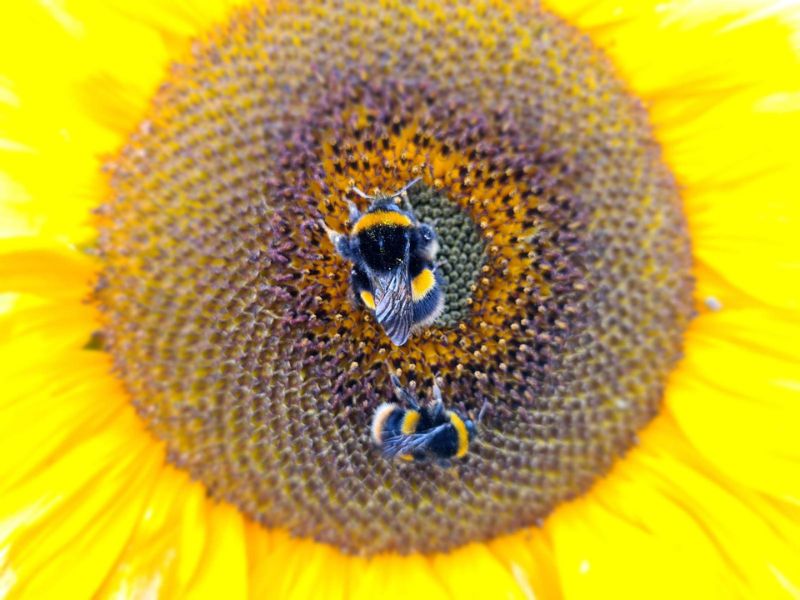
By the time national Insect Week came around at the end of June, we were able to share the amazing fact that one of our specialist volunteers, entomologist David Notton, has identified an incredible 676 insect species at the farm so far (and still counting).
This biodiversity is not so obvious to everyone, so we were glad to be able to celebrate it with a special event in the allotments. Our Insect Day raised awareness of the importance of insects and education on improving biodiversity within allotment plots and home gardens.
David, and another specialist volunteer Huw Pennell, led small groups on guided walks around the allotments, discussing different growing methods, the importance of insects within the ecosystem, and ways to manage biodiversity and ecological imbalances.
For the children, Agnes and Hannah delivered a play/theatre-based educational session. Using the Crankie Theatre (an illustrated paper scroll that is ‘cranked’ by hand to create a moving panorama in a box) to tell the Lauriston Farm Bug Story, they provided an interactive introduction to the importance of insects. Following the session, children took part in a Wildflower and Bug Hunt around the Community Garden. Each child received a wildflower plant (donated by Lauriston Wildflowers) and wildflower seeds.
We all shared soup, juice, and biscuits, helping build the human connections and community links.
The event was a huge success! We had over 60 attendees, and participants actively engaged in the workshops and activities, with many commenting on how much they had learned about insects and biodiversity. Children shared how much they enjoyed the Wildflower and Bug Hunt. And we hope to repeat it – fingers crossed for an even higher species count by Insect Week 2027.
Why Monitor Insects?

Insects tell us an important story of the health of our ecosystem. The presence of some insects can tell us how well we’re doing with habitat improvements, or highlight what’s happening with climate change. This is because insect populations react rapidly to changes in the environment. The insect monitoring at the farm also feeds information into national monitoring databases (eg. at iRecord, Butterfly Conservation and Bumblebee Conservation Trust).
Insects and Lauriston Agroecological Farm
We have set aside areas for wildlife and created habitat, including tree and wildflower planting, and bee hotels. We don’t use pesticides. This means a wide range of insects can coexist happily with the farm’s activities. They can also be beneficial for food growing in the market garden and allotments, as pollinators and predators:
Bees, wasps, hoverflies, moths, beetles and butterflies are crucial pollinators for many crops.
Social wasps, parasitic wasps, hoverflies, lacewings, ladybirds, black snail beetle and ground beetles help keep populations of slugs, snails and aphids etc in balance.
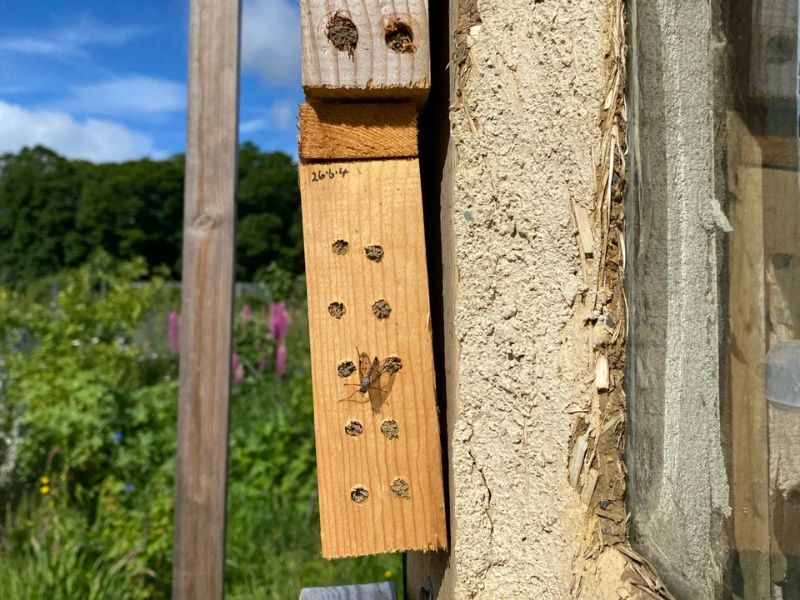
‘Bee hotel’ boxes for Red mason bees, fixed to the wall of the community kitchen. Most of the cavities are occupied – the mud in the holes indicates that bees are at home!
Insects are also food for many other creatures who live at the farm, e.g. Skylark, Meadow pipit, Grey partridge, Grasshopper warbler, Sedge warbler, Stonechat, Reed bunting, hedgehog, and badger.
Amongst David’s long list, there are some unexpected finds: the soldier fly Four barred general (new to Scotland); Flat wasp (new to Scotland); and the Dark Spinach moth found in the allotments is listed as Vulnerable on the Great Britain Red List due to long-term declines.
Get Involved with iNaturalist
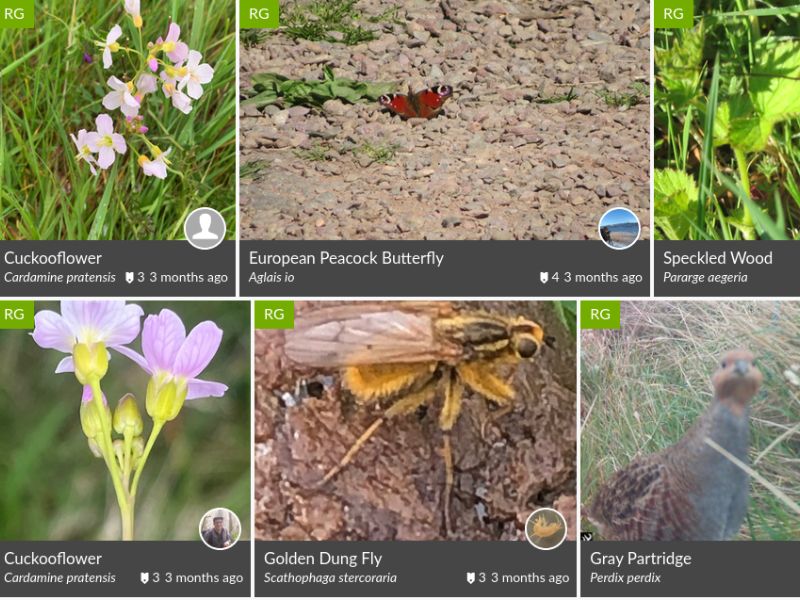
A snapshot of the farm’s iNaturalist page
David is an entomologist and logs his sightings elsewhere for research purposes. However, there is a way for everyone to get involved in recording the life you see at the farm. We’ve recently also reached 700 observations (357 species) logged on iNaturalist. These are a mix of cultivated and wild plants, birds, fungi, invertebrates and mammals. The iNaturalist page is really beginning to paint a picture of the transformation from a nature-poor sheep farm into a vibrant, nature-rich farm with food for many species.
At the moment, we have a small number of dedicated folk logging their sightings (with tree volunteer Bob Glen the #1 spotter) – and you are welcome to get involved. It’s free, you just need to have access to a camera, and create an iNaturalist login, and you can start uploading your sightings to the ‘Lauriston Farm’ project. If you’re not sure who you’re looking at, the iNaturalist community can help. For example, if you spot an insect you don’t know, just take a photo and upload it, mark as ‘insect’, then other iNaturalist members can see your observation and offer a specific name. So it’s a good way to learn – you don’t have to be an expert
Click here to go to the Lauriston Farm page on iNaturalist to see the observations and get started
There is also an app (of course). Click here to get the iNaturalist app for Android, or here to get the iNaturalist app for Apple