Farm News | February 27, 2026
Seed at the Farm – A Big Update
We look back at all the work on seeds in 2025 at the farm, and forward to all the plans for 2026…

There are a lot of elements to our seed saving and sharing work at the farm. Here we pull together all the different projects from last year, and the work ahead. If you’re into seeds, this one is for you. Dive in…
A Look Back at Seeds in 2025

Seed Kist
2025 was a great year for seed-saving on the farm. As usual we started the year by cracking open our Seed Kist to share all the treasures within. People left with bags full of seed for the year and people brought us their own seed riches from their gardens for us to add to the shared wealth of the kist.
Crowd-breeding Network
2025 was the second year that the farm participated in a UK and Ireland wide community seed-saving project based on farmer-led diversity-focussed plant breeding.
Why is this important?
We’ve lost 75% of genetic diversity in our crops over the last century. By allowing promiscuous pollination between varieties, we re-pool genetics and create opportunities to restore this lost diversity. By increasing diversity, we increase the potential for resilient and adaptable crops better able to grow in our changing climate. The aim of the project is to create new evolutionary populations that are promiscuously pollinated, genetically diverse and locally adapted.
How does it work?
As a community of growers, we agree which crops we would like to grow. We then grow an agreed seed mix of varieties of that cultivar and let them cross pollinate at each of our sites. Once the seeds are collected and saved from the plants, we re-pool them all and then redistribute to do the same again. We also meet online once a month to learn from each other. Thanks to coordination by the Gaia Foundation’s Seed Sovereignty project, we also have various seed breeding experts join us on these monthly chats.
Why are we doing it like this?
Working collaboratively speeds up the plant-breeding process, and very importantly, spreads the risk of crop failure. In our first year, we had a 30 metre bed of broad beans sown as part of this project and every single seed was eaten by mice! But the project went on because of the dozen or so other growers. Having multiple flocks on multiple farms means we bulk up the seed stock faster and there’s even more opportunity to enhance genetic diversity. As the project is farmer led, it will also lead to seeds adapted to thrive in local soils and climates.
The 2025 crowd-breeding crops at the farm were: Kale, Summer Squash, Collards and Broad Beans.
Market Garden Seeds
Pumpkin Quest
Over the last few years, we’ve been exploring which pumpkins thrive best in our climate and which are most delicious. It’s been a fun ride and we’ve had highs and lows along the way: some may remember the somewhat ridiculous, though amazing, pumpkin tasting we held in 2023 where we discovered – amongst other things – that trying to taste more than 40 varieties of pumpkin in one go was a limit! (I’m counting this as a high), or the great slug decimation of 2024 (a definite low). We were excited in 2025 to have the opportunity to partner with Seeds of Scotland to grow a seed crop for them of the beautiful landrace variety, Desert Spirit Squash. This ticked all our variety boxes in terms of being beautiful, productive and delicious as well giving us the chance to help steward the seed to become better adapted to growing conditions in Scotland and support the wider movement towards seed sovereignty in our region. The crop grew beautifully, our CSA members and market stall shoppers got to enjoy the fruits of our labour and you can now buy the seed from Seeds of Scotland if you’d like to grow and steward this delicious pumpkin yourself. We also have extra saved seeds to share with you from the Kist if you’re local to us or money would be a barrier.

Beetroot
Another beautiful seed crop we produced that you can find at Seeds of Scotland is Jannis Beetroot. A classic globe-shaped deep purple beetroot with a sweet, mild flavour. This crop was stewarded at the farm by the inimitable Toby Hodgkin as part of our collaborations with the Scottish Seed Hub. As a biennial crop (flowering and setting seed in its second year) this type of seed requires careful planning, patience and commitment, beyond what you might first expect for a humble and often overlooked staple.
Bean Quest
Beans are gloriously beautiful, delicious and beneficial for helping improve soils. We grow a diverse selection each year for our CSA members and market stall including broad beans and fine French beans, and more recently have explored sharing some as ‘demi-sec’ (i.e. fresh podded beans). Our long term goal is to supply our community with food from the farm year round. As well as growing more storage crops and winter greens we are interested in how we can supplement fresh veg with stored and dried goods. We are excited about the potential to develop a farm grown dried bean mix that would be available through the winter and spring months. Over the past couple of years we have been trialling different varieties of bean. Bulking up scarce varieties (from only a couple of beans!) and testing more familiar ones. We are working to identify varieties that are tasty, productive and able to grow quickly enough to reach maturity and drying stages in our short season. In 2025 we saved seed from more than 25 varieties and plan to continue refining our selection and scaling up production. Under the banner of Bean Quest we also consider ‘soup peas’ a whole other category of delicious drying legume that we are hoping to adapt for production in the Market Garden and through the allotments.
Garlic
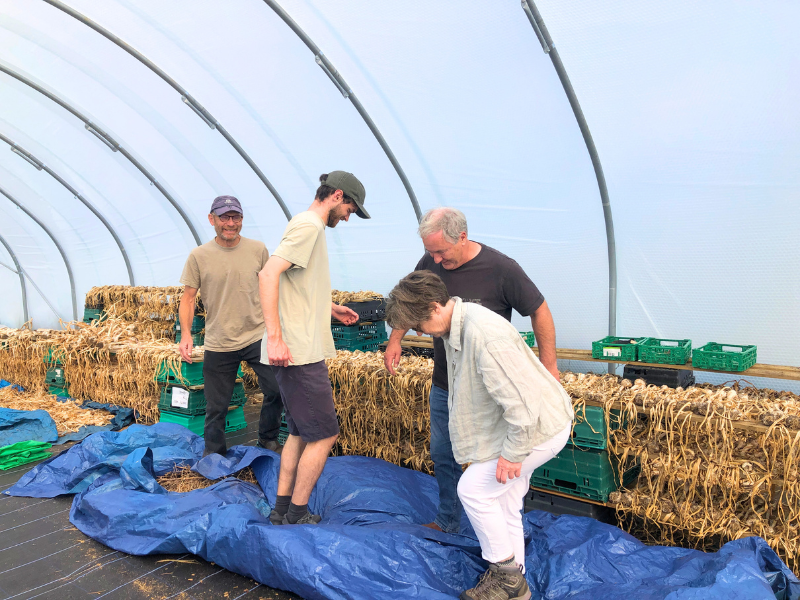
Not a seed, but like the seeds, we have been saving and replanting our own garlic cloves since 2022, bulking up and adapting four varieties to our land. Barring any disasters, we are now self-sufficient for our garlic needs. Since the beginning we’ve grown both soft and hard necked garlic. The vision for soft necked garlic was that we’d be able to braid plaits of them for folk: beautiful, functional and delicious! The reality is that soft necked garlic isn’t too happy in colder/damper climates and often the leaves break down before drying well enough to plait. It’s been gradually getting happier with us and the Scottish weather (and each year we select the best bulbs to replant). Finally, after four years we got a crop of garlic that we could plait! Hopefully this is indicative of plant adaptation and not just clement weather so fingers crossed more braids this year too.
Lettuce
Through Market Garden grower Daisy doing the Gaia Foundation’s year-long Seed Production Training course, we saved seed from our favourite lettuce ‘Flashy Lightning Butter Oak’ – a delicious speckled oakleaf/ butterhead cross variety that has performed well for us in all weathers the last few seasons. ‘FLBO’ has an incredible combination of traits, being quick-heading, compact and dense, but still with substantial leaves that give great crunch and flavour, adding good weight and visual interest to a salad mix. The dark purple-red flashes make it stand out from other varieties, but this is also the most variable of its traits, so we plan to selectively breed for density and saturation of the flashes, in plants that really thrive in our coastal Scottish climate. Continuing to develop a farm population through careful selection will hopefully further enhance its performance here and cement its place as an absolute staple in our salad mix.
Coal Bean
Separate to Bean Quest, Daisy’s other seed crop for the Gaia Foundation course was a 19th century heirloom runner bean with a personal connection. The ‘Coal Bean’ was bred in Bridgnorth (the town her mum grew up in and grandparents still live in) but is also recorded by seed saving expert Sue Strickland as being cultivated in St Martins (a small village that Daisy grew up in that rarely gets a mention) – both places with mining heritage in the industrial West Midlands. The variety has bright pink beans inside that turn completely black as they dry, unlike other runners that have a characteristic speckle to them. As a lesser known and stewarded variety, the bean is not available in commercial catalogues, but the Heritage Seed Library had a small number stored that they were able to share. This has allowed us to begin to bulk up seed and rebuild the population, with the hope to distribute it back to family members to steward in the seed’s ancestral lands.
Our Wheat
It was so exciting to see a whole field of our wheat being sown in September this year, over three acres! Rouge D’Ecosse is an old Scottish variety of wheat. It’s mentioned in an 1880 book by Henry De Vilmorin (a famous Parisian grain merchant importer) called Les Meilleurs Blés, where he praises it for its winter hardiness. Until 20 years ago, it had been almost been lost as a variety, until work by Andy Forbes searching gene banks uncovered a small amount of seed, which eventually made it back to Scotland with Andrew Whitley from Scotland the Bread. Scotland the Bread bulked the seed up and shared it to farmers and growers across Scotland in an effort to keep it alive. In 2016, some of that wheat made it to Granton Community Gardeners who grew it on a street corner on Wardieburn Road. Every year, they saved the seed and sowed another patch. When the farm started in 2022, we knew we wanted to grow grains. Granton Community Gardeners also has a community bakery and they were keen to get a local grain system going that could provide locally grown and milled flour. They gave us the seed from one of their street corners which we used to sow 500 square metres of wheat. We saved that seed and in 2023 we sowed half an acre. We then saved that seed again and in 2025 were able to sow over three acres. The three acres will be harvested this summer and (if everything goes to plan), 2026 will be our first year of producing flour for sale – a really huge milestone. We will continue to steward this old Scottish variety, as well as trialling other grain varieties like our Hebridean Rye and other population wheats together with Granton Bakery to develop locally adapted, tasty wholegrains and baked goods.
Our Seedy Networks
North Edinburgh Seed Saving Initiative
At the end of 2025, a group of local people interested in seed saving got together collaborate on getting more seed grown in North Edinburgh for sharing in the community. It was great to get the first group of enthusiasts together and 2026 should result in the first batches of community-grown seed being ready for sharing in our communities.
Scottish Seed Hub
We continue to work with a group of market gardeners who also produce vegetable seed across Scotland. This included East Neuk Market Garden, Upper Baillard Farm, Beth Webb (Kircudbright) and Sustainable Kirriemuir. The group is aiming to launch a seed catalogue in 2027, and in the meantime have been sharing seeds and developing a business plan for seed production and sales.
Common Grains
We are members of Common Grains, a network of Scotland-based growers, millers, bakers and grain researchers. The network meets online every 1-2 months, as well as in person a couple of times a year. We are grappling with some of the key issues involved in creating a healthy Scottish grain network. Most grains currently grown in Scotland are for the alcohol industry or animal feed. We want to see diverse populations of grains being produced for healthy nutritious food that is affordable to people. There are many folk involved, including Scotland the Bread (Fife), Lapwings Mill (Stonehaven), Wild Hearth Bakery (Comrie), Cereal Bakery (Tongue) and Bruntlands Bread (Elgin) to name just a few.
UK Grain Lab
Through Common Grains, we are also part of a UK-wide network of growers, millers and bakers. Common Grains is part of RISE: Resilient Infrastructure for a Successful Emergence in the UK’s Grain Economy, a project which has established a Community of Practice to address key challenges facing those working on the ground in their transition towards an agroecological grain system. The vision is to see the movement more connected, organised and skilled as we move forward to change the grain system together. We believe a more diverse, democratic and decentralised grain system is possible.
Seed Fest
Last year, we again participated in the regular Scottish Seed Fest, this time organised at the Camphill Community in Newtondee, where everyone shared seeds, told seed stories, and exchanged ideas for building a more resilient future. In June, there was a second day organised for members of Common Grains to get together to discuss all sorts of grainy things. We covered small-scale machinery, grain varieties and how to share these, developing more campaign materials around real bread, and sharing resources around teaching people how to bake sourdough.
The Seed Gathering (Wales, October 2025)
This was the most brilliant gathering of seedy people from across the UK and beyond, organised by the Gaia Foundation’s Seed Sovereignty Programme. A whole two days at the Centre for Alternative Technology for seed people to gather and support each other. There were sessions on legislation, soil, grains, seed libraries, seed-processing, seed poetry, music and art, and so much time to sit down together and talk about all the many ways we are all beholden to seed.
“We saw a future of diversity, resilience, abundance, flavour, joy, connection and community.”
Click here to see more reflections and inspiration from the Seed Gathering
Some of the 2026 Seed Plans
North Edinburgh Seed Saving Initiatives
We are planning to jointly grow some beetroot, soup peas, and tomatoes. For now that is the list, but more may be added. This group is still open to anyone interested to join, so do look out for our meeting dates in the newsletter.
Seed Libraries in Local Libraries
This spring, we will open small seed libraries in Granton, Muirhouse and Drumbrae libraries. These will be set up so people can pick up seeds for their gardens and leave seeds that they can’t use. More news to follow in our newsletters.
Seed Shares and Tattie Day
We have already been sharing seeds and will crack open the Seed Kist again on Tattie Day (Sunday 1 March) for people to come and pick up seeds and drop any of their surplus off to share with others. On Tattie Day, we will also have bags of seed tatties and onions for sale at a low cost.
Seed Saving Workshops
Late summer and autumn 2026, we will again be running seed saving courses. We will also include seed saving in the six week Introduction to Growing Your Own Food course which runs in May/June time. Sign up to our newsletter to hear when bookings open.
Continuing the Development of Diverse Populations
This January, the UK and Ireland crowd-breeding network gathered up a hill in a hostel in North Wales to plan the next crops and strategise. It was three days of so much laughter, conspiring, delicious food, fun and joy. We are also hoping to get some of the population varieties that we are developing registered with the Open Source Seed Initiative.
Scottish Seeds for Sale
Via Seeds of Scotland and the Scottish Seed Hub, we are hoping to get more Lauriston-grown varieties together with other Scottish-grown open-pollinated seed out into the market place for everyone to be able to access better seed.
Seed Sufficiency in the Market Garden
We want to work towards producing, and sharing, more of the seed we use in our market garden production. This is for climate resilience and also community-sufficiency. We grow commercial volumes of seed production and diversity for the benefit of the community (of individuals and other market gardens here in Scotland). Our goal is not to produce all our own seed, but be part of a thriving network of professional growers producing and trading high quality, climate adapted seed for Scotland. The myth of self-sufficiency is a modern one. Even the most capable households (or farms) exist within networks of exchange and shared labour. Skills, knowledge and goods passed from one hand to the next.
Resilience comes from openness and sharing, not isolation – a shared local system thrives, grows and adapts (just like seed).